A substance limit is not a fiber label
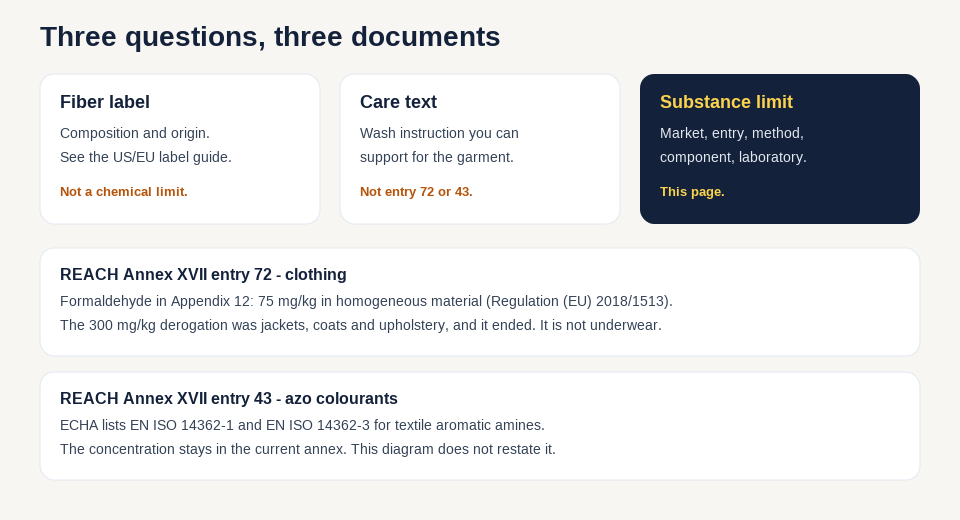
Buyers often fold three jobs into one sentence: the fiber label, the wash instruction, and the chemical limit. They have different texts. The US and EU label guide is the fiber, origin and care comparison. The care-label note keeps care wording off the brand mark. This page does not repeat them. It covers restricted substances, using EU texts a buyer can open, and it says where a US or UK shipment is a separate reading.
Nothing here is a test report or a legal opinion, and no style on this site is described as screened. The factory prints a substance claim only if you supply wording your adviser has accepted. Name the market, the entry, the method and the laboratory in the enquiry, and confirm which components can be sent. A photograph is not a chemical result.
Who decides the list
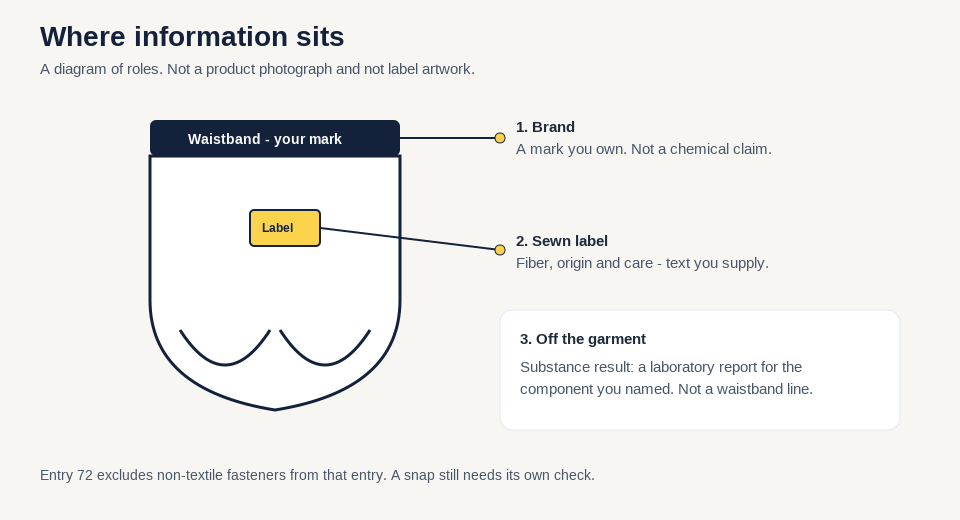
The brand or the importer decides which market’s rules apply. A factory can cut cloth and ship a specimen. It does not choose the law by sewing a waistband. If you sell in more than one market, write each list. A body, a dyed waistband, a print and a metal snap are different materials. Entry 72, below, excludes non-textile fasteners from that entry. The snap can still sit under a different rule. “Test the garment” is not a specimen plan.
EU clothing restriction: Annex XVII entry 72
Commission Regulation (EU) 2018/1513 amended Annex XVII to Regulation (EC) No 1907/2006 (REACH). The National Archives text of that regulation adds entry 72. The entry restricts the substances listed in its appendix when they are present at or above the concentration given there, measured in homogeneous material, in consumer clothing, in related accessories, in textiles other than clothing that touch the skin to a similar extent, and in footwear. The regulation’s own wording places that limit on goods placed on the market after 1 November 2020, with the exclusions written in the entry.
Appendix 12 of the same regulation lists formaldehyde, CAS 50-00-0, at 75 mg/kg. The entry also contained a time-limited derogation: for formaldehyde in jackets, coats or upholstery, the concentration used for that paragraph was 300 mg/kg from 1 November 2020 until 1 November 2023, and the appendix concentration applies after that. Men’s underwear is not a jacket, a coat or upholstery. Do not borrow the old 300 mg/kg figure for a brief. Read the consolidated Annex XVII before you copy any figure into a purchase order, because later amendments can change a table that a 2018 text introduced.
The entry, as published in that amendment, does not apply to clothing made exclusively of natural leather, fur or hide, to non-textile fasteners and non-textile decorative attachments, or to second-hand clothing. A metal snap is a reason to look at the exclusion and then at whatever other entry covers that metal, not a reason to ignore the cloth. The regulation also says the new restriction sits alongside any stricter restriction elsewhere in the annex or in other EU law. Entry 72 is not the whole of REACH.
How formaldehyde is measured
ISO 14184-1:2011 specifies a water-extraction method for free formaldehyde and formaldehyde extracted partly by hydrolysis. ISO’s catalogue says it can be used on textile samples in any form, and that the procedure is intended for a stated range on the fabric, with results below the lower limit reported as not detectable. Quote the method, including that reporting rule, so a “not detectable” line is not rewritten as zero by someone who did not read it. ISO 14184-3:2023 is a later extraction method that uses liquid chromatography. The catalogue describes it as selective and intended where a coloured extract would interfere. It is not a nickname for part 1.
The part 1 catalogue entry points to a different question, released formaldehyde, in ISO 14184-2. This page does not describe part 2 because that text was not the page used here. If your laboratory manual says “formaldehyde” without a part number, stop and ask which part. A water-extraction result and a released-formaldehyde result answer two briefs. AATCC TM112, formaldehyde release by the sealed-jar method, is a further method with its own title. Do not swap it for ISO 14184-1 because both sentences contain the word formaldehyde.
Azo colourants: Annex XVII entry 43
REACH Annex XVII entry 43 is the azocolourants and azodyes entry. It is older than entry 72 and it is still the entry buyers mean when they ask whether a dye can release restricted aromatic amines from a textile that touches the skin. The legal concentration sits in the current entry. This page does not restate that concentration, because the ECHA document opened for the method list is a compendium of analytical methods, not a substitute for the annex.
That compendium, under entry 43, names EN ISO 14362-1:2017 for textiles: detection of the use of certain azo colourants that can release listed aromatic amines, with and without extracting the fibres. It names EN ISO 14362-3:2017 for the determination of certain aromatic amines derived from azo colourants which may release 4-aminoazobenzene. Leather methods are listed beside them. Underwear cloth is a textile question; a leather-only trim would be the other pair. The compendium footnote points to Commission Regulation (EU) 2020/2096 as the instrument that harmonised those methods. Open that regulation and the current entry together before you freeze a method year in a contract.
A dyehouse declaration that “we do not use banned dyes” is not the test in EN ISO 14362-1. It can still be a useful purchasing control. It does not replace the laboratory result your retailer asked for. Specify the component that was dyed. A white body and a black waistband are two dye questions. A print is a third.
Great Britain and the United States are separate readings
The text cited above is the EU regulation, as published on legislation.gov.uk by the National Archives. Selling in the European Union means following the current EU annex. Selling in Great Britain means checking UK REACH, including whether the relevant annex entries still match the EU text you were given. This page does not claim the two lists are identical, and it does not claim they have diverged. The UK destination brief is where you name Great Britain as the market. Northern Ireland is a question to put to your adviser in words, not a footnote this page can settle.
The United States does not import entry 72 by osmosis. Adult men’s underwear is not automatically inside a European clothing restriction because the cloth was cut for a US brand. US apparel flammability, textile labels and origin records are already outlined on the US import checklist. Use that page for those topics. Use this page only to remember that a substance limit is an extra question for the US importer, who may be looking at state warning rules or at a retailer’s private manual. Do not paste the EU 75 mg/kg formaldehyde figure onto a US purchase order unless the importer has told you that figure is the one they use.
What to send before anyone books a lab
- The market or markets, named separately if you sell in more than one.
- The entries you want checked, with the regulation you read, not a nickname.
- The method and edition, matched to the entry. Formaldehyde part 1 is not part 3, and it is not an azo method.
- The component: body, gusset, waistband, print, sewing thread, or a non-textile part you have been told sits outside entry 72.
- Who chooses the laboratory, who receives the report, and which production lot the specimen comes from.
- The wording, if any, you want printed. No wording is a valid choice. Invented wording is not.
Bring that list to the enquiry. The OEM route is where a new cloth is still being chosen. The quality page is where you record what a sample is allowed to prove, which does not include an unstated chemical result. If the only document you have is a fiber label, you are on the compliance guide, not at the end of this one.
- US and EU fiber-label checklist
- Care labels, kept separate from substance limits
- EU destination brief
- UK destination brief
- US import checklist: flammability, labels and origin
- OEM route
- Send the market and the method list
Sources
The limits and method names in this note were checked against the pages below. Consolidated legal text can move. Open the current annex before you treat a figure as the one in force.
- Commission Regulation (EU) 2018/1513, adding REACH Annex XVII entry 72
- ISO 14184-1:2011, free and hydrolysed formaldehyde, water extraction
- ISO 14184-3:2023, formaldehyde by liquid chromatography
- AATCC TM112 listing, formaldehyde release, sealed jar
- ECHA compendium of analytical methods, entry 43 azo methods
Common questions
Is 75 mg/kg a factory test result?
No. It is the formaldehyde concentration listed for Appendix 12 in Commission Regulation (EU) 2018/1513. It is not a measurement of any style on this site. Confirm the consolidated annex still states that figure before you write it into an order.
Does the jacket derogation of 300 mg/kg apply to underwear?
The derogation in that regulation was for formaldehyde in jackets, coats or upholstery, and it was limited to the period ending 1 November 2023. Men’s underwear is not that product. Do not copy the jacket figure onto a brief.
Does an EU chemical test clear a US shipment?
No. Entry 72 is an EU placing-on-the-market rule. A US importer has its own list. Flammability, textile labels and origin for US underwear imports are discussed on the US import checklist, not in this note.
Can the factory choose the laboratory wording for a hangtag?
No. Send wording your adviser has accepted, or send none. A method name on a report is not automatically a sentence you may print for shoppers.
What this guide does not replace
What a page does not replace is stated once in the buyer FAQ.
Entry numbers and method names are a reading list. They are not a test report and not wording for a label.
- Buyer FAQ
Quotation, certificate, duty and purchase-order limits.
What to send next
Send the lines this page leaves open. The links below are the enquiry and pages this guide already names.
- Send the enquiry
The form already on this page. It records the enquiry.
- US and EU label checklist
Fiber names and care text. Not a substance limit.
- EU destination brief
Name the market. The brief does not state a duty or a test result.
- OEM route
Where a new cloth is still being chosen.
Ready to brief a style?
Send a reference garment or sketch, the quantities you are considering and your destination. The quotation will state what is included and how minimums are counted.