A lab test is not a visual inspection
Buyers ask for “the usual underwear tests” and then discover that two labs ran two different methods. A test method is a procedure with a scope. It says what it measures, on what kind of material, and what it refuses to measure. The number on the report is meaningless until the purchase order says which method, which edition, which specimen and which result you will accept. This page names methods that show up on men’s underwear specs. It does not set those acceptance numbers, and it does not report a result for any cloth on this site.
Visual inspection answers a different question: how many pieces in a sample drawn from a lot show defects you can see or measure with a tape. The inspection guide describes defect classes and AQL sampling. A laboratory does not replace that, and a clean inspection does not mean the cloth will keep its size or its colour after washing. Put both in the order if you need both. Do not write “tested” as if it named a method.
What you write, and what to confirm with the factory
You choose the market, the methods, the conditions, the acceptance values, the laboratory, and the component: body, gusset, waistband, print or thread. The factory can cut specimens from the approved cloth and send them where you direct, if the enquiry says so. A fit sample is not automatically a set of laboratory specimens. A salesman swatch is not the bulk dye lot.
Ask the laboratory whether a method’s scope covers your knit. Several methods below are written for woven cloth. A number outside the scope is not a pass. YXLP does not publish pass limits or attach reports to catalog styles. If a quotation is silent on testing, the tests have not been agreed.
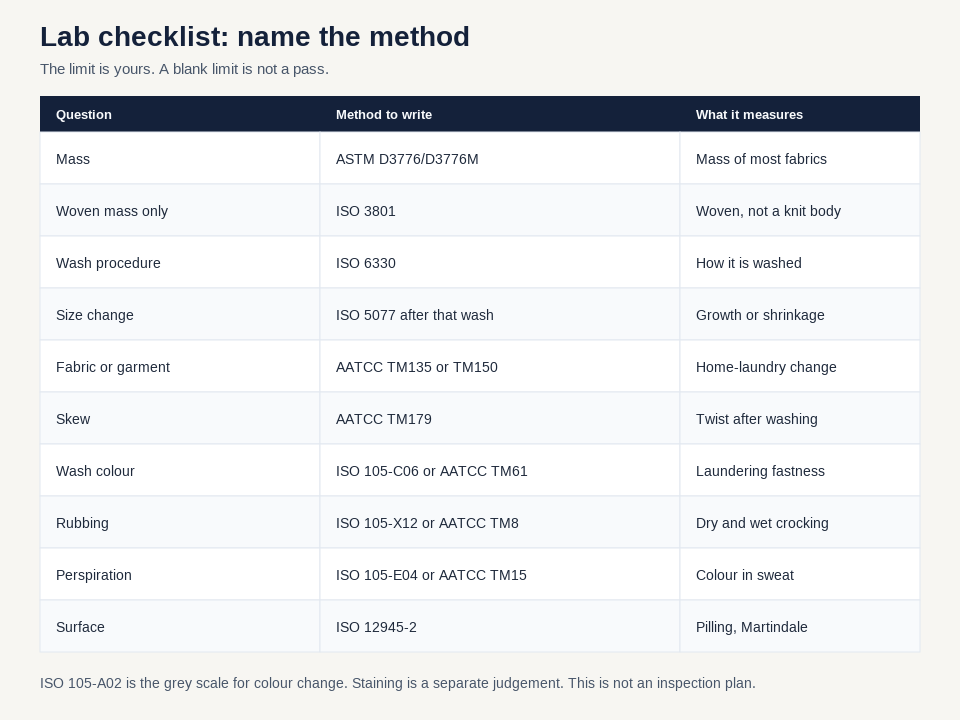
Mass per unit area
Fabric mass per unit area is what briefs call GSM. It describes the cloth. It is not the whole spec. ASTM D3776/D3776M covers mass per unit area of most fabrics, with more than one option for a piece, a roll or a small cutting. Name the option if you care which one is used.
ISO 3801:1977 is titled Textiles — Woven fabrics — Determination of mass per unit length and mass per unit area. The catalogue text limits it to woven fabrics. Do not write “ISO 3801” on a knit underwear body and assume the scope fits. If your lab prefers a knit method, name that method in the spec. Compare the result with the swatch you approved, not with a round number from an old title.
Shrinkage, growth and skew
Dimensional change is how much a fabric or a garment grows or shrinks when it is washed and dried in a stated way. ISO 6330:2021 specifies domestic washing and drying procedures for textile testing. It covers several reference washing machines and several drying methods, including line dry, drip dry, flat dry, flat press and tumble dry. A report that says “washed” without the procedure, the machine type and the drying method cannot be compared with another report.
ISO 5077:2007 specifies how to determine dimensional change of fabrics, garments or other textile articles after an appropriate combination of washing and drying. It is the calculation companion to a wash procedure such as ISO 6330. It is not itself a description of the wash. Write both numbers if you want both.
AATCC publishes home-laundering methods with different specimens. TM135 is dimensional change of fabrics. TM150 is dimensional change of garments. A fabric result does not describe a waistband stretched in sewing. TM179 is skew change after home laundering, the twist buyers see when a side seam walks. You still write the largest change you will accept.
Colour fastness
Colour fastness is resistance to a named attack: washing, rubbing or perspiration. ISO 105-C06:2010 covers domestic or commercial laundering with a reference detergent. A single cycle and a multiple cycle are different tests. The multiple test is the more severe one. Do not compare them as if they were the same.
ISO 105-X12:2016 specifies colour fastness to rubbing, with a dry rubbing cloth and a wet rubbing cloth. That is the test buyers mean when a dark brief stains a light trouser. ISO 105-E04:2013 specifies colour fastness to perspiration. Underwear sits in sweat, so a wash-only report leaves that question open. ISO 105-A02:1993 is the grey scale for assessing change in colour. When a report quotes a step on “the grey scale”, say whether it is this scale for colour change. Staining of an adjacent cloth is a separate judgement. Do not treat one step as if it covered both.
AATCC methods are what many US buyers already name. AATCC TM61 is colorfastness to laundering, accelerated. AATCC TM8 is colorfastness to crocking. AATCC TM15 is colorfastness to perspiration. They are not automatic substitutes for the ISO methods. Write the method your retailer named.
Pilling, fuzz and matting
Pilling is fibre balled on the surface after abrasion. Fuzz and matting are related. ISO 12945-2:2020 is a modified Martindale method for that propensity. Write the rub count and the rating you will accept. A report with no rub count is unfinished.
Stretch, growth and elastic tension
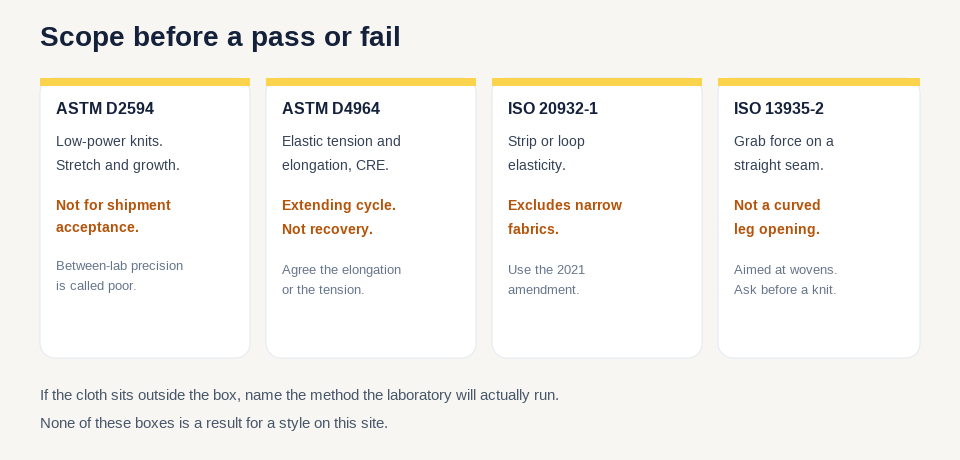
Underwear cloth has to stretch and return. ASTM D2594/D2594M measures stretch of low-power knits under a known load, and growth after an extension is applied and removed. ASTM says it is not recommended for acceptance testing of shipments because between-laboratory precision is poor, and that support fabrics are better evaluated with other methods, including ASTM D4964. Do not write D2594 onto a high-power waistband and treat it as a contract number.
ASTM D4964 measures tension and elongation of wide or narrow elastic fabrics on a constant-rate-of-extension machine. The people using it must agree the loop tension or elongation at which the result is read, and results compare only when the machine setup matches. The described readings are on the extending cycle. They are not a recovery percentage. If you need recovery, name a method that reports it.
ISO 20932-1:2018, with Amendment 1 from 2021, specifies strip or loop tests for elasticity of fabrics, excluding narrow fabrics. ISO 20932-2:2018 is the multiaxial pair, also excluding narrow fabrics, and those two multiaxial results are not interchangeable. A waistband elastic is often narrow, so check the exclusion before you cite either part for the band. The body and the band can need two methods.
Seam force, and where the method stops
ISO 13935-2:2026 is the grab method for maximum force to rupture a seam, force perpendicular to the seam, on a constant-rate-of-extension machine. The catalogue text aims it at woven fabrics, including wovens with an elastomeric fibre, and says it can apply to other techniques. It is for straight seams, not curved ones. A brief’s leg opening is often curved. Ask the lab whether the method fits before you set a pass value. If it does not, name the method they will actually run.
| Question | Name this | Do not leave as |
|---|---|---|
| Mass | ASTM D3776/D3776M option, or the knit method the lab will use | “GSM” with no method |
| Wash change | ISO 6330 plus ISO 5077, or AATCC TM135 or TM150 | “shrinkage tested” |
| Skew | AATCC TM179 if twist is a complaint | “looked straight” |
| Wash colour | ISO 105-C06 single or multiple, or AATCC TM61 | An unwashed photo |
| Rubbing | ISO 105-X12 dry and wet, or AATCC TM8 | “no crocking” |
| Perspiration | ISO 105-E04 or AATCC TM15 | A wash test standing in for sweat |
| Surface | ISO 12945-2 and the rub count | “anti-pilling” with no count |
| Stretch | A method whose scope matches the cloth | D2594 as a contract test against ASTM’s caution |
| Seam | ISO 13935-2 only if the lab confirms scope | A curve assumed to match a straight grab |
A briefing order that survives a second lab
For each line, write the component, the method and edition, the condition, whether the specimen is fabric or a garment, the laboratory, and the value you will accept. Say whether the test is on development cloth, pre-production, or bulk. The first-order checklist is where you decide which lines must exist before you compare quotations. The tech pack guide is where the lines are stored. Copy method numbers from a retailer’s manual instead of translating them into the nearest ISO number.
- Inspection and AQL, which is not this laboratory list
- First-order checklist: what to lock before quotations
- Tech pack guide
- Quality page: what a sample is allowed to prove
- OEM route for a cloth that still has to be sampled
- Send the method list with the enquiry
Sources
Method titles and scope notes below come from the publisher catalogue pages opened for this note. Acceptance values are not in those titles. Do not copy a procedure out of a secondary article, including this one, into a contract.
- ASTM D3776/D3776M, fabric mass per unit area
- ISO 3801:1977, woven fabric mass
- ISO 6330:2021, washing and drying procedures
- ISO 5077:2007, dimensional change
- AATCC TM8, TM15, TM61, TM135, TM150, TM179
- ISO 105-C06:2010, colour fastness to laundering
- ISO 105-X12:2016, colour fastness to rubbing
- ISO 105-E04:2013, colour fastness to perspiration
- ISO 105-A02:1993, grey scale for colour change
- ISO 12945-2:2020, Martindale pilling
- ASTM D2594/D2594M, low-power knit stretch
- ASTM D4964, elastic tension and elongation
- ISO 20932-1:2018, strip elasticity
- ISO 20932-2:2018, multiaxial elasticity
- ISO 13935-2:2026, seam rupture, grab method
Common questions
Will an order include a laboratory report?
No. This site does not publish test results. Name the methods, the laboratory and the limits in the enquiry if you want testing agreed before bulk.
Is ASTM D2594 the underwear stretch test?
Only for a low-power knit inside that scope. ASTM says it is a poor acceptance test for shipments and points support fabrics toward other methods, including D4964. D4964 reports tension and elongation, not a recovery percentage.
Can ISO 13935-2 grade a brief’s leg opening?
Not by assumption. The grab method is for straight seams and is aimed at wovens, with a note that other fabrics can fall inside it. Ask the laboratory before you set a pass value on a curved knit join.
Where do inspection and these tests meet?
Inspection samples a lot for defects you can see or tape-measure. These methods measure what the eye cannot score. The inspection guide plans the lot sample. The tech pack stores the method list.
What this guide does not replace
What a page does not replace is stated once in the buyer FAQ.
The checklist names methods. It does not set a pass limit or attach a report to a style.
- Buyer FAQ
Quotation, certificate, duty and purchase-order limits.
What to send next
Send the lines this page leaves open. The links below are the enquiry and pages this guide already names.
- Send the enquiry
The form already on this page. It records the enquiry.
- Quality checklist
What a sample is allowed to prove. Not a laboratory result.
- Inspection guide
How a finished lot is sampled by eye. A different record from a lab test.
- First-order checklist
Lines to lock before you compare quotations.
Ready to brief a style?
Send a reference garment or sketch, the quantities you are considering and your destination. The quotation will state what is included and how minimums are counted.