A letter is a label, not a waist
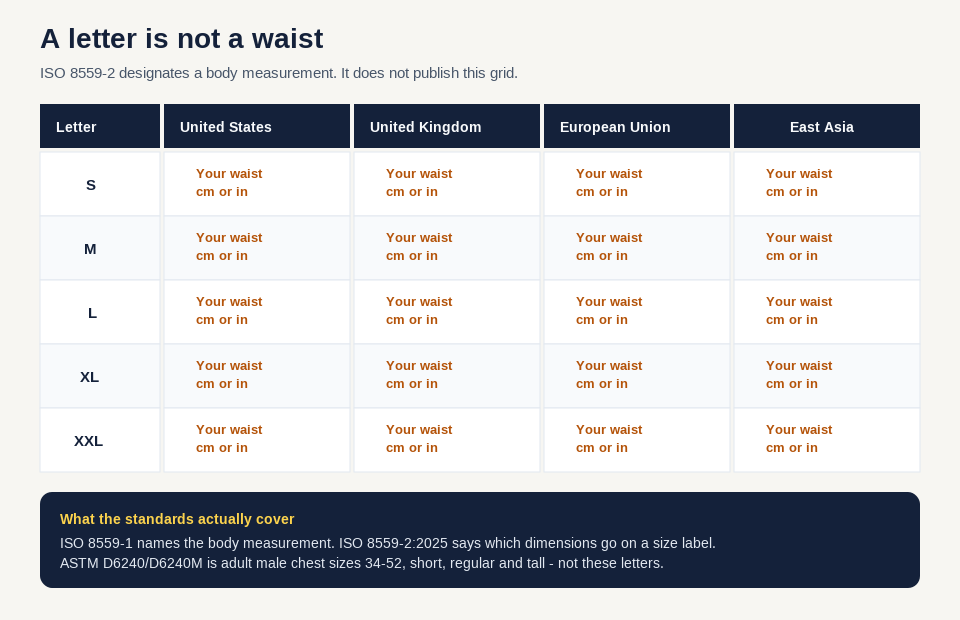
Buyers search for one chart that turns S through XXL into a single waist. No international standard does that. A letter is a name a brand prints. The body it refers to is a decision the brand writes down. Two brands can print the same letter on two bodies. Two factories asked to follow “medium” will sew two garments unless the brief says which body, and which finished measurements, that letter means.
A catalog photograph does not show where the tape sat, or whether the waist was relaxed or stretched. YXLP does not publish a house size chart. The size-grading guide tells you to send the chart you sell. This page is the step before that: how to name the body so another team can read the chart.
Keep the body chart separate from the finished spec
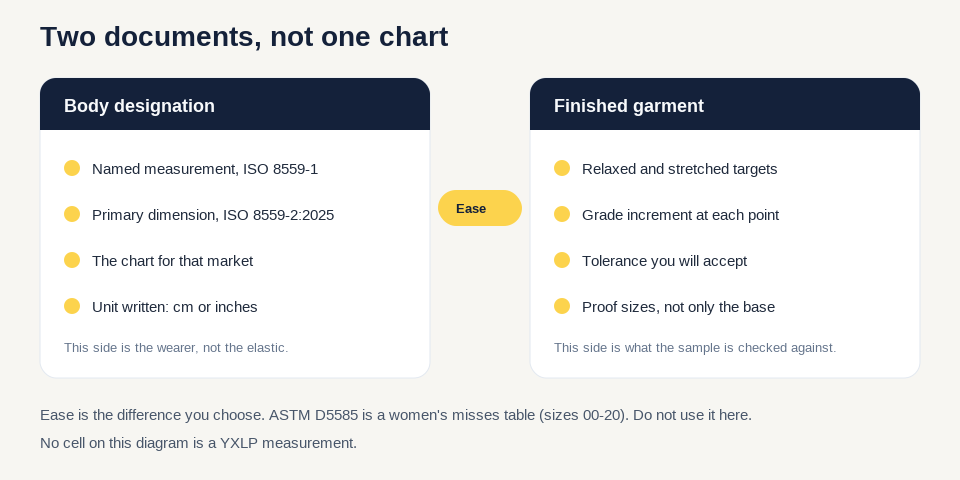
A size designation tells a wearer which body the garment was cut for. A finished specification tells a sewing line how long each seam is. Those are different numbers. The body waist is a girth around a person. The garment waist is a length of elastic and cloth, measured relaxed and again while it is stretched. Ease is the difference you choose between them. A close brief has little ease. A relaxed brief has more. The same body chart can sit under both, with two finished specs.
Write them in that order. Name the body measurement. Then write finished measurements at the base size, relaxed and stretched where the point moves. Then write how each finished point changes at the next size. A tolerance is the band around a finished measurement that you will still accept. It is not a second grade. Put it on the finished spec, in the same unit, and say that a measurement outside the band fails that piece.
| Column | What belongs there | What does not belong there |
|---|---|---|
| Market | The country or channel whose shoppers will read the label | A guess that one letter works everywhere |
| Body chart | The size names you sell, tied to named body measurements | A finished elastic length |
| Base size | The one size you will approve first | Approval of the sizes on either side |
| Finished spec | Relaxed and stretched values at each point of measure | A number read off a photograph |
| Grade rule | The change at each point from this size to the next | One change copied onto every point |
| Tolerance | The band you will accept around each finished point | A reason to skip the grade |
| Proof sizes | The smallest and largest you need to see in cloth | A base-size sample standing in for the run |
ISO names the body, not the garment
ISO 8559-1:2017, Size designation of clothes — Part 1: Anthropometric definitions for body measurement, is the current international list of how to take body measurements for clothing. ISO’s catalogue describes it as a guide for building size and shape profiles for garments and fit forms, and as a way for teams to use the same measurement principles. Waist girth is one of the girths in that list. The standard also describes a pictogram approach in an annex. It does not assign your letters, and it does not tell a factory how much ease to add.
ISO 8559-2 says which of those body measurements are the primary and secondary dimensions for stated garments, so a label can point at a body. Use ISO 8559-2:2025, published in September 2025. ISO 8559-2:2017 is withdrawn. The withdrawn catalogue text said designation is based on body measurements, not garment measurements, and that the maker chooses garment measurements for how the piece is worn. Do not assume the 2025 tables repeat that wording. ASTM’s men’s table also points at ISO 3635, which the ISO 8559-1 record lists as the withdrawn predecessor ISO 3635:1981. Replace a “measure to ISO 3635” line with the current part of ISO 8559.
A chest-size table is not an underwear grade
ASTM D6240/D6240M is titled Standard Tables of Body Measurements for Adult Male, Chest Size Range 34–52 Short, Regular, and Tall. The scope on ASTM’s page says the tables list body measurements for that adult male figure type, and that those body measurements can be a baseline for designing clothes once fabric, ease, styling and fit are considered. The sizes in the title are chest sizes, with short, regular and tall lengths. They are not S–XXL underwear labels, and they are not the relaxed waist of a brief.
Use D6240/D6240M when you want a published adult-male body baseline and you will read the tables you bought. Then do the underwear work the standard does not do: choose ease, rise and leg opening, and write the finished spec. Citing the number without the ease is not a grade.
ASTM D5585 is a different document. Its title is Standard Tables of Body Measurements for Adult Female Misses Figure Type, Size Range 00–20. It is a women’s misses table. It is the wrong baseline for a men’s underwear size run. Buyers sometimes meet D5585 in a general “apparel grading” search and paste it into a men’s file. If a reference pack includes it, take it out of the men’s spec and say which men’s source you are using instead.
The same letter across markets
United States, United Kingdom, European Union and East Asian retail letters are brand conventions. ISO 8559-2 does not convert a US medium into a centimetre waist, and it does not make a UK letter of the same name the same body. If you sell one style in more than one market, send the body chart for each market, in centimetres or inches, and say whether the finished spec is shared. A number with no unit, or a unit with no landmark, is as ambiguous as a letter. A pictogram copied from another brand’s hangtag is artwork. There is no honest single conversion for East Asian retail letters either. Attach that market’s chart, or say you do not have it yet. Do not ask the factory to invent one.
How to write the grade and the tolerance
A grade increment is the change from one labelled size to the next at one point of measure. The waist can change by one amount and the leg opening by another. Take each increment from your chart and the ease you chose. If a point does not change, write that the increment is none.
Fit tolerance is the acceptance band on the finished garment, not on the wearer. Decide it per point. State the unit, whether the band sits on both sides of the target, and the condition: relaxed, stretched, or after the wash you named. Agree whether the tape follows the edge, whether the garment is flat, and whether a stretched measure uses a stated load. A hand pull is not a method you can repeat.
- Name the base size and mark it on the grade table.
- For each point, write the finished target and the increment to the next size.
- Write the tolerance next to that point, in the same unit.
- Say which sizes must be sewn before bulk, not only the base size.
- Say whether a fail is judged per piece or per measurement point.
What to send with the enquiry
Send the cut, the markets, the body chart, the finished spec for the base size, the grade rule, the tolerance, and the proof sizes. Say which document wins if they disagree. The tech pack guide is where those points of measure are listed. The size-grading guide is the shorter note on locking a grade you already have. The plus-size brief is the place to name a run that goes past your usual letters. None of those pages fills the numbers in for you.
The factory can cut to the spec you send. It should not invent the chart, the increment or a market conversion. Confirm which file is current. A new body starts on the OEM route. Labels on an agreed body still need the grade. A logo does not set the waist.
- Size grading for a chart you already have
- Tech pack guide: where the points of measure sit
- Plus-size brief, when the run goes past your usual sizes
- OEM route, when the body itself is still open
- Send the chart and the finished spec
Sources
Titles and status below are from the publisher pages opened while this note was written. The standards are paid documents. This page does not reproduce their tables or their measurement procedures.
- ISO 8559-1:2017, anthropometric definitions for body measurement
- ISO 8559-2:2025, primary and secondary dimension indicators (current)
- ISO 8559-2:2017, withdrawn and replaced by the 2025 edition
- ASTM D6240/D6240M, adult male body measurements, chest sizes 34–52
- ASTM D5585, adult female misses body measurements, not a men’s table
Common questions
Does this page include a men’s underwear size chart?
No. It describes how to separate a body chart from a finished spec, and which public standards define body measurements. The numbers on the label you sell have to come from you. YXLP does not publish a house chart.
Is ASTM D5585 a men’s grading standard?
No. ASTM D5585 is the body-measurement table for adult female misses sizes 00–20. For an adult male body baseline, ASTM publishes D6240/D6240M, and even that table is chest sizes with short, regular and tall, not an underwear letter chart.
Can one grade cover the US, the UK, the EU and an Asian retailer?
Only if you have checked that those shoppers are being offered the same body. A shared letter is not that check. Send a body chart per market, and say whether the finished spec is shared or separate.
Who writes the tolerance?
You do. Put it on the finished spec, point by point, and name the measuring condition. The factory can sew to a tolerance you wrote. It should not choose one so the sample has something to pass.
What this guide does not replace
What a page does not replace is stated once in the buyer FAQ.
The diagrams show where a body chart ends and a finished spec begins. They do not fill a waist, a grade or a tolerance.
- Buyer FAQ
Quotation, certificate, duty and purchase-order limits.
What to send next
Send the lines this page leaves open. The links below are the enquiry and pages this guide already names.
- Send the enquiry
The form already on this page. It records the enquiry.
- Size grading guide
How to record a grade you already have. Not a chart from this factory.
- Tech pack guide
Where finished measurements are written. This page does not fill them.
- Plus-size brief
The end of a grade you send. A photo is not an extended fit.
Ready to brief a style?
Send a reference garment or sketch, the quantities you are considering and your destination. The quotation will state what is included and how minimums are counted.